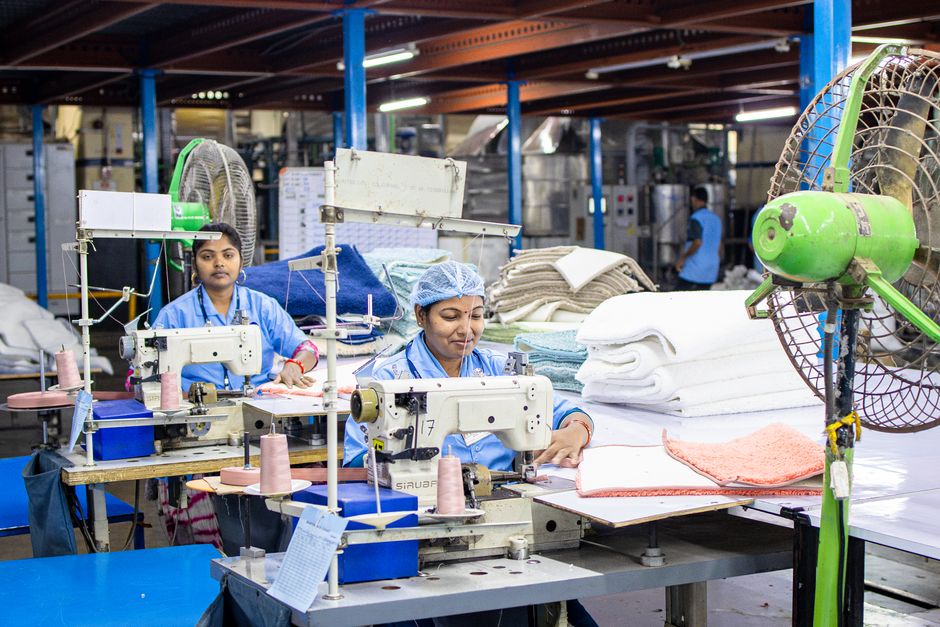
Tirupur and Ludhiana are two of India's biggest apparel clusters, and neither of them fits into an off-the-shelf ERP without a fight. A Tirupur unit is knitting, dyeing, cutting, stitching and packing knitwear for export buyers who want exact size and colour breakups against a purchase order. A Ludhiana hosiery and woollen maker is running seasonal ranges of socks, T-shirts, thermals and sweaters through a web of contractors. In both cases the real business lives in the style, the size-colour matrix and the job work moving between an in-house floor and dozens of outside karigars — and that is exactly what generic software struggles to hold.
This guide looks at how garment and hosiery manufacturing actually flows in these clusters, why generic ERP and Tally-as-is break down for apparel, which features genuinely matter on the floor, and how to think about cost when you're choosing a system in 2026.
How garment and hosiery manufacturing actually flows
An apparel order almost never starts as a simple item. It starts as a style — a specific design with its own fabric, trims, construction and, critically, a matrix of sizes and colours. One style might ship as S/M/L/XL across four colours, which is sixteen distinct sellable variants that all share the same costing and BOM but need to be tracked separately in production and dispatch. Generic software that treats each size-colour as an unrelated SKU turns a single style into an unmanageable list; software that has no matrix at all forces the whole thing into spreadsheets.
From the style, a bill of materials (BOM) defines what goes in: fabric (grey or dyed knit, yarn for hosiery), and trims — thread, buttons, zippers, labels, elastic, packing material. That BOM drives raw-material planning and per-style costing. The physical work then moves through stages that are frequently outsourced: knitting or fabric procurement, dyeing, cutting, stitching, checking, ironing and finishing, and finally packing against the export or domestic order.
- 1Style and BOM set up — fabric, trims and the size-colour matrix for the order
- 2Fabric and yarn sourced or knitted, then sent for dyeing
- 3Cutting — fabric issued and cut into panels by size, with cut quantity tracked per lot
- 4Stitching / job work — bundles sent to in-house lines or outside contractors (karigars)
- 5Checking, ironing and finishing before packing
- 6Packing by size-colour ratio against the buyer's PO and dispatch with documentation
At each outsourced stage, material leaves the premises and comes back — cut panels go to a stitching contractor, grey goes to a dyer — and someone has to know how much was issued, how much returned, what was rejected, and what that contractor is owed. Multiply that across a season's worth of styles and lots, and the tracking is the business.
Why generic software fails apparel makers
Generic accounting and inventory tools were built for buy-and-sell trading or for factories that make a fixed catalogue of standard products. Apparel is neither. Here is where it consistently breaks:
- No size-colour matrix — every variant becomes a separate manual item, so a 16-variant style balloons into chaos and stock never reconciles by size.
- No real job work tracking — issuing cut bundles to a contractor and receiving finished pieces back, with rejections, isn't a standard purchase or sale, so it ends up in a diary.
- Weak BOM and consumption — fabric and trim usage per style can't be planned or compared to actual, so wastage and shortages go unnoticed until dispatch.
- No lot / production tracking — you can't see where a style's order stands stage by stage, or which lot is stuck at stitching.
- Contractor / karigar payments are off-system — piece-rate settlements by operation get calculated on paper, inviting disputes and leakage.
- No per-style costing — fabric, trims, job work rates and overheads don't roll up into a true cost per style, so quoting export buyers is guesswork.
- Export orders and documents are separate — PO size breakups, packing lists and shipping documents live outside the system.
The tell-tale sign
If your factory prints GST invoices from the computer but tracks cutting, job work issue-return and karigar dues in registers and Excel, you don't have manufacturing software — you have a billing tool. The production reality is happening off-system, which is exactly where cost leaks and disputes hide.
What garment and hosiery software should actually do
Apparel-specific software is built around the style and the job work, not around a flat item list. The table below maps the features that matter to why they matter on a Tirupur or Ludhiana floor.
| Feature | Why it matters |
|---|---|
| Style master with size-colour matrix | One style holds all its size-colour variants together for stock, production and dispatch — instead of hundreds of loose SKUs that never reconcile. |
| BOM for fabric and trims | Defines fabric, yarn, thread, buttons, labels, elastic and packing per style, so you can plan requirements and compare planned vs actual consumption. |
| Cutting and lot tracking | Records fabric issued and pieces cut per lot and size, giving a real base quantity to follow through stitching and finishing. |
| Job work issue and return | Tracks bundles and grey sent to contractors and dyers, quantities received back and rejections — the core of an outsourced apparel supply chain. |
| Contractor / karigar accounts | Piece-rate settlement by operation and per contractor ledgers, so payments are calculated from recorded work, not from memory. |
| Raw material and fabric inventory | Yarn, grey and dyed fabric, and trims stock by unit (kg, metre, dozen) with consumption tied to production, so shortages surface before dispatch. |
| Production / order status by stage | Shows where each order stands — cutting, stitching, finishing, packing — so you can promise realistic delivery to buyers. |
| Export order and documentation | Captures the buyer PO with size breakups and produces packing lists and dispatch documents against it. |
| Per-style costing | Rolls fabric, trims, job work and overhead into a cost per style so export and domestic quoting is grounded in real numbers. |
| GST invoicing and e-way bill | Correct HSN, GST invoices and e-way bill data for movement of goods, connected to the same production and stock records. |
Costing per style: where the money is made or lost
The single most valuable thing apparel software gives you is an honest cost per style. Add up fabric at actual consumption, trims from the BOM, dyeing and stitching job work rates, checking and finishing, packing and overhead, and you have the floor below which you cannot quote. Without it, a factory wins an export order on price and only discovers at the end of the season that the margin was never there. With costing tied to actual consumption and actual job work rates, you can quote confidently and spot the styles that quietly lose money.
Want to see how a style, its BOM, job work and costing fit together for your unit?
Explore our Manufacturing ERPGST, e-way bill and export compliance
Whatever the software does on the floor, it still has to keep you compliant. Apparel movement — grey to a dyer, cut bundles to a stitching contractor, finished goods to a buyer — often crosses value thresholds that require an e-way bill, and every invoice needs the right HSN and GST treatment. Software that links production, stock and billing means the same recorded transaction that moves goods also produces the compliant invoice and e-way bill data, rather than re-keying everything twice. For exporters, keeping the buyer PO, packing details and shipping documents in one place makes the paperwork far less painful.
What it costs and how to choose
At Wizix, Manufacturing and Textile ERP starts from ₹49,999. The final figure depends on how much of the flow you want covered — a unit that only needs style, stock, job work and GST billing sits near the entry point, while one that also needs multi-stage production tracking, export documentation, detailed per-style costing and integrations will invest more. The honest way to price it is against the workflow, not a per-seat sticker.
When you evaluate options, weigh them against how apparel actually works:
- Does it handle a real size-colour matrix, or will every variant become a manual item?
- Can it track job work issue and return with rejections, and settle contractors by piece rate?
- Does BOM-driven consumption and per-style costing come standard, or as an expensive add-on?
- Will it produce GST invoices and e-way bill data from the same records that run production?
- Does the vendor understand Tirupur/Ludhiana workflows, or are they demoing a generic factory template?
- Is pricing tied to your workflow and honest about what's included, with training and support after go-live?
The factories that get the most from apparel software are the ones that move cutting, job work and karigar settlement onto the system — not just the invoice printing.
If your unit in Tirupur or Ludhiana is running its real production in registers and Excel while the computer only prints bills, the gap is worth closing. Software that speaks styles, matrices and job work turns that scattered tracking into one reliable picture — and gives you the per-style costing to quote and grow with confidence.
Frequently asked questions
Why can't we just use Tally or a generic ERP for our garment unit?+
Tally and generic ERPs are built for trading or fixed-catalogue manufacturing. They have no native size-colour matrix, no job work issue-and-return tracking, no BOM-driven fabric consumption and no per-style costing — so apparel makers end up keeping the real production in registers and using the software only to print invoices.
What is a size-colour matrix and why does it matter?+
A single style ships in multiple sizes and colours — for example S/M/L/XL across four colours is sixteen variants. A size-colour matrix keeps all of them under one style for costing and BOM while still tracking stock, production and dispatch by each variant, instead of forcing you to create hundreds of unrelated SKUs.
Can the software track job work sent to outside contractors?+
Yes. Apparel software records material and cut bundles issued to stitching contractors and grey sent to dyers, the quantities received back, and rejections. It also maintains contractor ledgers and settles piece-rate payments by operation, so karigar dues are calculated from recorded work rather than memory.
Does it help with export orders and documentation?+
It captures the buyer purchase order with its size breakups, tracks production against it stage by stage, and produces packing lists and dispatch documents. Keeping the PO, packing details and shipping paperwork with the production data reduces re-keying and errors.
How does per-style costing work?+
The system rolls up fabric at actual consumption, trims from the BOM, dyeing and stitching job work rates, finishing, packing and overhead into a cost per style. That gives you a floor for quoting export and domestic buyers and highlights styles that are quietly unprofitable.
Does it handle GST invoicing and e-way bills?+
Yes. It produces GST invoices with correct HSN and generates the data needed for e-way bills on goods movement, drawing on the same production and stock records so you're not entering the same transaction twice.
How much does garment and hosiery software cost?+
At Wizix, Manufacturing and Textile ERP starts from ₹49,999. The final cost depends on scope — a unit needing style, stock, job work and GST billing sits near the entry point, while multi-stage production tracking, export documentation, detailed costing and integrations increase the investment.
Is this suitable for both Tirupur knitwear and Ludhiana hosiery makers?+
Yes. The underlying flow — style, size-colour matrix, BOM, cutting, job work, contractor settlement and costing — is common to Tirupur's knitwear exports and Ludhiana's hosiery and woollens. The software is configured to each cluster's specific stages and product ranges.
Related Wizix solutions
Sources & references
Ready to get started?
Get honest advice and a clear, no-obligation quote from the Wizix team.
Get a free quote