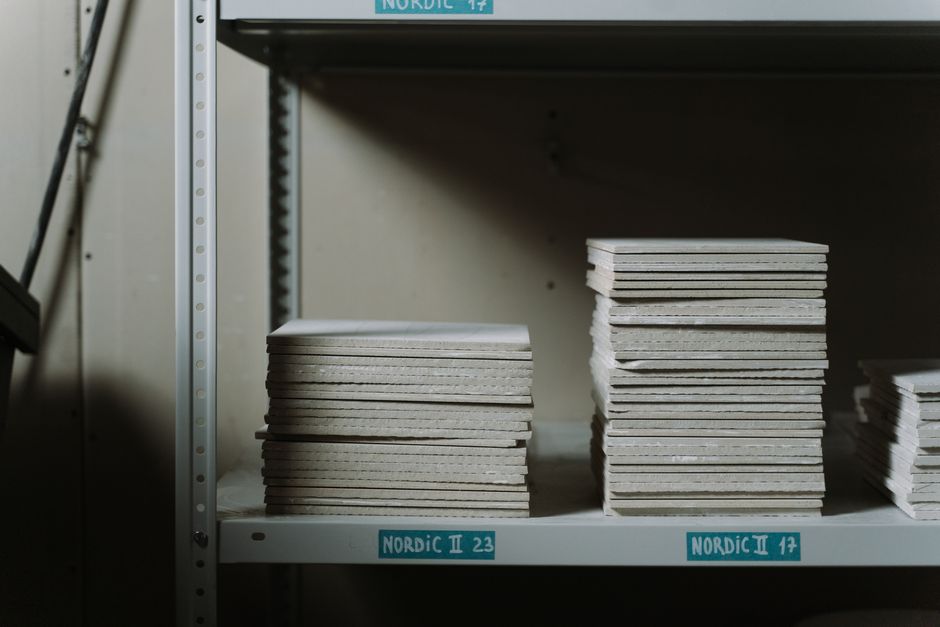
Morbi produces a huge share of India's ceramic tiles, vitrified tiles and sanitaryware, and very little of that trade fits a standard ERP screen. A tile unit here isn't selling one clean SKU off a shelf — it's making the same 600x600 design in several shades and grades from the same firing, packing it into boxes measured in pieces and square metres, and shipping it to a dealer in Bihar and a container to the Gulf in the same week. When the software can't see shade, lot, grade and box-to-sqm together, the factory ends up running the real business on WhatsApp and a stack of loading slips, and using the computer only to print an invoice.
This guide is about closing that gap. We'll walk through how a Morbi production and dispatch cycle actually flows, why generic ERP breaks down for tile makers, which features genuinely matter, and how to think about cost when you're choosing a system.
How a Morbi tile factory actually runs
Before you judge any software, you have to be honest about the workflow it must support. A typical ceramic or vitrified tile line moves through a set of stages, and stock changes character at every one of them.
Body preparation and pressing
Raw materials — clay, feldspar, quartz and additives — are weighed to a recipe, milled into slip or spray-dried into powder, and pressed into green tiles. This is where a batch begins. The recipe and the batch of body powder used carry through everything that follows, which is why body prep can't be an afterthought bolted onto a sales system.
Glazing, printing and firing
Green tiles are dried, glazed and digitally printed with a design, then fired in a long kiln. Firing is the moment that decides shade and grade. Even with tight control, the same design comes out of the kiln in slightly different shades from batch to batch, and with varying levels of surface perfection. The software has to expect this — it can't assume one design equals one uniform product.
Sorting, grading and packing
After firing, tiles are sorted by shade and graded — commonly premium (first quality), commercial (standard/second), and economy or reject grades. They're then boxed. A box holds a fixed number of pieces that add up to a known area, so the same lot has to be countable as boxes, as pieces, and as square metres at once. Get this mapping wrong and every stock figure downstream is wrong too.
Warehousing and dispatch
Finished boxes go into a large finished-goods warehouse, often tracked by design, size, shade and lot. Dispatch pulls specific shade lots for specific orders — because a customer who ordered 500 boxes of one shade will reject a load that mixes two. Loading is by truck or container, with weight, box count and transport paperwork to match.
Why generic ERP fails tile and sanitaryware makers
Off-the-shelf ERP and accounting tools aren't bad — they're just built around a general assumption: one item, one unit, one uniform stock. Tile manufacturing violates that assumption at almost every step. The item you sell isn't just a design; it's a design in a specific size, shade, lot and grade, counted in three units at once. A flat item master simply can't hold that.
- Units don't match reality — you produce and sell in boxes, pieces and square metres together, but generic tools force one unit and leave you doing conversions by hand on every entry.
- Shade and lot vanish — the same design fires in different shades, and orders must ship on a single shade lot, but generic stock has no place to record it.
- Grade is ignored — premium, commercial and economy come from the same firing at different prices, and a flat SKU can't separate them cleanly.
- Batch traceability is missing — when a firing or glaze problem shows up, you can't trace which body batch and kiln run it came from.
- Huge finished-goods stock becomes a guess — with thousands of design-size-shade combinations, warehouse position drifts away from reality fast.
- Export and domestic orders share one rigid invoice format, so export documentation and costing get handled off-system in spreadsheets.
- GST rates, HSN and e-way bills need manual attention, which is exactly where penalties creep in.
The real cost isn't the software — it's the mismatch
When shade lots aren't tracked, orders ship mixed and come back as rejections and freight losses. When grade split from a firing isn't recorded, premium tiles quietly get billed as commercial. When a warehouse of thousands of combinations lives in memory, dead stock piles up unnoticed. Tile-specific software pays for itself less by saving typing and more by making those losses visible.
Shade, lot and grade: the part generic tools miss
If there is one thing that separates real ceramic software from a repurposed billing app, it is shade and lot matching. Because firing introduces natural shade variation, buyers care intensely that every tile in a lot matches. Software built for tile makers treats the combination of design, size, shade and lot as the real stock-keeping unit, so you can promise a customer a specific lot, reserve it, and ship it without mixing. It also holds grade — premium, commercial, economy — against the same production run, so the value split from a firing is captured instead of blurred into one average.
In tiles, the invoice is easy. The hard part is guaranteeing that the 500 boxes on the truck are all the same shade lot — and that your books already knew that.
Inventory, warehousing and dispatch at scale
A Morbi unit can hold thousands of live combinations of design, size, shade, lot and grade, spread across a large warehouse or several godowns. Managing that by memory or a shared spreadsheet is where control is lost. Good software keeps the finished-goods position live — by location if you run multiple godowns — and lets dispatch reserve specific shade lots against confirmed orders, so a promised lot isn't accidentally sold twice. When a loading is done, box count, piece count, square metres and weight all reconcile from the same record, which is what makes the loading slip, invoice and transport paperwork agree.
Domestic and export orders together
Most Morbi manufacturers sell both to domestic dealers and into export, and the two have very different paperwork. A domestic dispatch needs a GST invoice with correct HSN and an e-way bill for interstate movement. An export order adds a proforma invoice, packing list, container and shipment details, and export invoicing conventions — and the software should carry one order through both worlds rather than forcing exports into a spreadsheet on the side. Keeping domestic and export on one system also means one honest view of total demand on the same finished stock, instead of two teams quietly fighting over the same shade lot.
Want an ERP built around shade lots, box-piece-sqm units, grade and export — not forced onto a generic template? See how our Manufacturing ERP is set up for tile and sanitaryware makers.
Explore Manufacturing ERPGas, fuel and production costing
Tile making is energy-heavy. Natural gas or other fuel for the kiln and spray dryer is one of the largest running costs, and it moves with fuel prices. If costing only counts raw material and ignores fuel and power per firing, the margin you think you have on a design may not be real. Software that lets you attach fuel, power and body-recipe cost to a production batch gives you a truer cost per box and per square metre — and lets you see which sizes and designs actually earn their kiln time. We won't quote a fuel figure here because it changes constantly; the point is that the system should let you feed in your real numbers rather than assume them.
GST, HSN and e-way bills
Ceramic tiles and sanitaryware carry their own HSN codes and GST rates, and rates can change, so always confirm the current rate and HSN for your specific goods on the official GST portal. In practice two things trip tile makers up: applying the correct rate and HSN consistently across a wide product range, and getting e-way bills right for interstate loads and higher-value movements.
- 1Tag every design-size with its correct HSN and GST rate once, so invoices stay consistent instead of relying on memory.
- 2Generate the e-way bill from the same invoice, rather than re-keying box counts and values into the e-way bill portal.
- 3Keep export documents — proforma, packing list, shipment details — linked to the same order for a clean audit trail.
- 4Reconcile your sales register with what's filed, so GST return time isn't a scramble.
Must-have features (and why each one matters)
Not every feature carries the same weight. Here's a practical checklist of what genuinely matters for a Morbi tile or sanitaryware unit, and the reason behind each.
| Feature | Why it matters |
|---|---|
| Box / piece / sqm units | Hold and bill the same stock in all three units at once, without converting in your head on every entry. |
| Shade & lot tracking | Guarantee every box in an order is the same shade lot, so loads don't get rejected for shade mismatch. |
| Grade handling (premium/commercial/economy) | Capture the value split from one firing instead of averaging premium and second-grade into one price. |
| Batch traceability | Trace a shade or defect back to the body batch, glaze and kiln run, so problems can be isolated and fixed. |
| Finished-goods warehouse by design-size-shade | Keep a live position across thousands of combinations and multiple godowns instead of guessing. |
| Shade-lot reservation on orders | Reserve a specific lot against a confirmed order so it isn't accidentally sold twice. |
| Production & fuel costing | Attach body recipe, fuel and power to a batch for a true cost per box and per square metre. |
| GST invoicing with HSN | Apply the correct rate and HSN consistently and produce compliant bills without manual lookups. |
| E-way bill support | Create e-way bills from the same invoice instead of re-entering box counts and values on a separate portal. |
| Export documentation | Produce proforma invoices, packing lists and shipment details from the same order as domestic sales. |
How the right software saves time and stops losses
The time savings are straightforward: units and HSN are set once, invoices and e-way bills come from the same screen, and export packing lists print instead of being typed fresh. The bigger win is control. When shade lots are reserved and shipped cleanly, rejections and return freight drop. When grade split is recorded off each firing, premium stops leaking out at commercial prices. When the finished-goods warehouse position is live, dead stock and repeated combinations surface early instead of at year-end. And when fuel and power sit inside batch costing, you finally know which designs are actually worth the kiln time.
What it costs and how to choose
Our Manufacturing ERP for tile and sanitaryware makers starts at ₹49,999. What a project actually costs depends on how much you need — the number of users, whether you want production and fuel costing, export documentation and multi-godown stock from day one, migration from an existing setup, and training for your staff. We'd rather scope that honestly with you than quote a flat number that hides surprises later.
When you compare options, weigh these:
- Does it handle box, piece and square metre for the same stock natively — or force you to convert by hand?
- Are shade, lot and grade first-class, so orders ship on a single matched lot?
- Can it trace a batch from body prep through firing to the finished box?
- Does it manage a large finished-goods warehouse, ideally across multiple godowns?
- Does it produce both GST invoices with e-way bills and export documentation from one order?
- Can it fold fuel and power into batch costing for a real cost per box?
- Is the pricing clear, and does it include migration and training, or are those extra?
A quick word of honesty
No software fixes a process nobody follows. The units that get the most out of a system are the ones willing to record shade lots and grade at packing consistently for the first few weeks. Once that habit forms, the control it gives back — clean loads, real costing, a warehouse you can trust — is hard to give up.
Wizix is a software agency based in Hyderabad, serving businesses across India, and our Manufacturing ERP is built for how ceramic, vitrified tile and sanitaryware production in Morbi actually works. If you're weighing up a move off spreadsheets or a stock system that never understood shade and grade, we're happy to walk through your real workflow first and tell you honestly whether it's the right time to switch.
Frequently asked questions
Which software is best for ceramic and tile manufacturers in Morbi?+
The best fit is software built around tile production — shade and lot tracking, grade handling, box/piece/sqm units, batch traceability, and both GST and export documentation — rather than a generic ERP. Wizix's Manufacturing ERP is designed around exactly this and starts at ₹49,999.
Can it handle shade and lot matching?+
Yes. Because firing introduces natural shade variation, the software treats design, size, shade and lot together as the real stock unit. You can reserve a specific shade lot against an order and ship it without mixing, so loads aren't rejected for shade mismatch.
Does it support box, piece and square metre units together?+
Yes. The same stock is held and billed in boxes, pieces and square metres at once, using the fixed pieces-per-box and area-per-box mapping, so you never convert by hand on every entry.
Can it separate premium, commercial and economy grades?+
Yes. Grade split from a single firing — premium (first), commercial (second) and economy or reject — is recorded against the production run, so the value difference is captured instead of averaged into one price.
Does it handle export orders and documentation?+
Yes. Domestic and export orders run on one system. Export orders can carry proforma invoices, packing lists and shipment details, while domestic dispatches get GST invoices and e-way bills — all from the same order and the same finished stock.
Can it trace a batch back through production?+
Yes. Batch traceability links a finished box back to its body recipe and batch, glaze, print and kiln run, so if a shade or defect problem appears you can isolate which production run it came from.
Does it account for gas and fuel in production costing?+
Yes. You can attach fuel, power and body-recipe cost to a production batch for a truer cost per box and per square metre. We don't assume a fuel figure, since prices change constantly — the system uses your real numbers.
How much does tile manufacturing software cost?+
Wizix's Manufacturing ERP for tile and sanitaryware makers starts at ₹49,999. The final cost depends on users, the modules you need (production and fuel costing, export documentation, multi-godown stock), data migration, and staff training. We scope it transparently rather than hiding extras.
Related Wizix solutions
Sources & references
Ready to get started?
Get honest advice and a clear, no-obligation quote from the Wizix team.
Get a free quote